Dear neighbours,

EPRA has learned to its horror that a walker was attacked on our very own streets because he was dressed in public as a Jew. Sam Brody, our neighbour, has our warm and angry sympathy. An attack on him, as on any person who walks among us, is an attack on all of us who live here. Hatred has no place in our neighbourhood and city; tolerance is central to our values.

EPRA

July 11, 2021

Dear Councillors,

As chair of EPRA I have already written a letter to the Planning and Housing Committee on the subject of the motion brought forward there by Councillor Wong-Tam, upon an initiative by the three councillors at Yonge and Eglinton asking for a careful study of the potential future of the city-owned lands at the southeast corner, currently occupied by the old bus barns, and by two office buildings.

I do not want to run through all the same arguments: that Yonge and Eglinton is very full of people, and that it looks to see its population double, that it lacks badly the social and cultural infrastructure its inhabitants require, that it is a strategic spot where two transit lines will cross, that this is the only chance to repair what’s missing. You know all that already.

Rather, i want to stress to you the remarkable unity of us citizens at Yonge and Eglinton — how strongly we want you to heed the advice of our local councillors. That working group we joined was remarkable for its harmony and energy. We had some eleven citizens’ groups, between the seven Residents’ Associations, the condo boards, the BIAs. a tenants’ association, the school trustees, and the three councillors. The dialogue was harmonious, inventive, and positive in its vision and its spirit.

One sign of how strong is our local backing is that cascade of almost 400 letters, all stirred up with only two days’ notice, and all produced between a Wednesday and a Friday. There are a lot more potential letters up here; everybody pretty well agrees that Yonge and Eglinton needs careful thinking and inspired vision.

We worry that some will argue for the inertial solution: look, we have the contract, we know the benefits, we fear legal entanglements. We say, in reply, do not walk away from the contract; it may turn out, with adjustments, to offer a solution. But perhaps not; our job at the moment is to step back and study our needs, our goals, and our legal obligations, with an open mind. That means passing the motion brought before you.

Tom Cohen

Chair, EPRA

cc the EPRA board and the members of the Midtown coalition

Re: Canada Square

Dear Neighbours:

Thanks to all of you who wrote almost 400 letters of appeal to move forward the visionary plan for Canada Square! On June 28, the Planning and Housing Committee discussed holding off final approval of Oxford’s proposal until city officials have finished assessing the implications of our report. EPRA, our allies, three local councillors and others supporting our cause were successful in convincing the PHC to refer this matter to City Council on July 14. Our mass of letters will surely influence the discussion.

We are attaching, for your information, a new article from Novae Res Urbis – a journal for planners, which is widely read. It lays out the story very clearly. Hopefully, it will strengthen our case even further.  

Thank you again for mobilizing on such short notice and for making the future of our community a priority. We will continue to keep you updated on this very important issue.

Epra

Has the Yonge-Eglinton Centre become a case study in how not do to urban intensification?

The Greater Toronto Area (GTA) is subject to intense economic and population growth pressures. Over the past two decades, a strong consensus has emerged that it is better to manage this growth by increasing the density of housing and employment in existing urban areas rather than through low-density, sprawling-outwards development.

The problems of sprawl are clear. In the GTA, outwards sprawl is onto the largest concentration of prime agricultural land in Canada, as well as major natural heritage and hydrologic features and systems, notably the Oak Ridges Moraine and Niagara Escarpment. Low-density development at the urban fringe exacerbates traffic congestion and is impossible to service with cost-effective transit services. The long-term costs of maintaining infrastructures spread of large areas exceed what can be acceptably collected through property taxes.

To address these problems with the dominant development patterns in the GTA, in 2006 Ontario enacted a Growth Plan for the region. The plan was intended to check the expansion of urban boundaries and concentrated new growth in existing urban areas. The goal was to create “complete communities” where it would be possible to live, work, play, shop, and go to school without needing to drive. Transit and active transportation (i.e. walking and biking) would be the primary modes of transportation.

The Growth Plan designated 25 locations in the region as urban growth centres. These centres were to have denser mixes of housing and employment, supported by access to higher-order transit (e.g. subways, GO Trains and LRTs). One such centre was at the intersection of Yonge St. and Eglinton Avenue in mid-town Toronto.

What has actually unfolded around the Yonge-Eglinton Centre over the past decade has been very different from the dense but mixed-use, “complete community” envisioned in the 2006 plan. Two fundamental problems have emerged. The first is that the form of development that has actually taken place has been almost exclusively residential, and overwhelmingly in the form of high-rise condominiums. The development of significant new employment sites, and in fact, of any other activities, such as cultural destinations, has been virtually nil.

The result is a location where, increasingly, people live, but do not work – a “vertical bedroom community.” Nor is the housing that has been built been very flexible. Rather it has largely taken the form of studio and one-bedroom (sometimes +) units. These are of scant use to growing families with children. Affordability has been an afterthought, and there have been substantial losses of existing affordable rental housing to the development boom.

The area’s new pre-development densities already exceeded the Growth Plan’s targets by a wide margin. As of 2006, the Yonge Eglinton Urban Growth Centre was already 600 people/jobs/ha (pjh), exceeding the Growth Plan target of 400 pjh by 50%.

Unbalanced development has led to a second problem. Throughout this period of explosive, single-use high-rise growth, infrastructure has remained largely static. A defining feature of mid-town Toronto development sites are signs posted by the Toronto District and Toronto Catholic Boards warning new residents that their children won’t be able to attend any of the area’s already overcrowded schools. The city has identifiedthe need for additional park space equivalent to four full-sized playing fields, plus another community centre to meet the needs of the area’s growing population. Daycare is scarce, and community gathering spots are in short supply. Cultural facilities are almost altogether lacking.

With no new employment at Yonge and Eglinton, most of the people moving into the area will be working somewhere else – a somewhere else they likely expect to reach onto Toronto’s already overcapacity Yonge subway southbound. To these commuters, the one major infrastructure project in the area, the Eglinton LRT line, will add additional passengers from the East and West, who will be coming not to work at Yonge and Eglinton, but to transfer south onto an even more overcrowded Yonge line.

When the city attempted, via a careful plan, to mitigate the area’s stresses, the province intervened to make things worse. In June 2019, the Ford government rewrote the City’s Midtown in Focus plan (a.k.a. Official Plan Amendment 405), which attempted to moderate the scale and regulate the form of new buildings in the area. As it were, the City’s proposals would still have allowed development to densities of 1020-1100 pjh – exceeding the original Growth Plan target by about 185%.

The province’s move, a “mega” example of its Ministerial Zoning Order (MZO) based approach to planning, went even further, removing height restrictions and other restraints on proposed buildings. The Province’s looser rules soon spawned proposals to add many new stories to high-rise projects already approved or in construction.

Getting the area’s development path back in line with the original vision for an urban growth centre means that infrastructures, of all types, need a chance to catch up with existing needs. That has to happen before any further development proceeds. The path forward from there must emphasize affordability and the area’s role as an economic, social and cultural destination. Better intensification models exist, like that seen in the redevelopment of Toronto’s North York Centre. But at the moment Yonge Eglinton Centre risks becoming a textbook example of how urban intensification should not happen.

Mark Winfield is a mid-town Toronto resident and Professor of Environmental and Urban Change at York University. He was involved in the development of the 2006 Greater Golden Horseshoe Growth Plan, and served on the Ministerial Advisory Committee on the Plan’s Implementation. Professor Winfield is a member of the board of directors for the Eglinton Park Residents’ Association

Dear neighbours,

When Oxford announced its plans for Canada Square, at the start we were all impressed by how much open space there was, but also somewhat rueful that the scheme “paid” for that amenity with five soaring towers, one of them far taller than E-condo. 

Dear neighbours,

When Oxford announced its plans for Canada Square, at the start we were all impressed by how much open space there was, but also somewhat rueful that the scheme “paid” for that amenity with five soaring towers, one of them far taller than E-condo. 

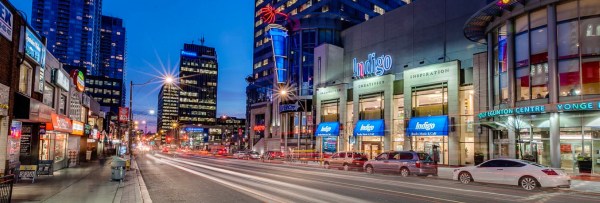
Then we began to think harder: our Midtown is growing so fast, and amenities and services have not at all kept pace. And the last thing we really need up here is 2700 new apartments. After all, this land, unlike most land here, belongs to the city, and it is a big plot, at the very intersection of two rapid transit lines. So it is our last chance to fill our many gaps and help make Yonge and Eglinton work well.

So can we not do better?

Thus began a discussion, among citizens, and a push with our three local councillors to slow things down. With their help, in late winter, the city set up a working group: seven Residents’ Associations, plus the Federation of North Toronto RA’s [FoNTRA], two condos, a BIA, a tenant’s association, and two TDSB board members. We had support from city staff, who attended every meeting. We held five meetings, all on screens, remarkably harmonious, creative, and up-beat, and, at the hand of the facilitator, drafted an eloquent report, to be released in about ten days. When it comes out, we will send it to you at once, and also post it on the EPRA website.

The central ideas:

  1. Canada Square should be a magnet, not just a mere place to change trains and go south. Its reach should be not local, but city-wide.
  2. It will need ample open space, relaxing, interesting and attractive.
  3. We all need, urgently, a K-8 public school.
  4. We also need affordable housing, in ample supply in the housing that does go up, but that housing should make up only 20% of the built space.
  5. Canada Square should have spaces for the arts, for assembly, and for social services.
  6. It should also incubate innovation, with jobs in the new economy that fit the many skills of residents here.
  7. A branch of a post-secondary institution would attract and anchor innovation and support the arts.
  8. All construction should be as “green” as possible.
  9. Canada Square should have a governing commission, like the one for Harbourfront, to steer development.

This plan neither presumes nor excludes a role for Oxford, the current developer. We are sending it to Toronto’s chief planner, with the understanding that he will write a report, for submission to the city’s Planning and Housing Committee. We are requesting from them that the city instruct its officials to evaluate its many implications: financial, legal, administrative, and material.

This is not at all the end of the story: if our plan makes headway, expect a long and lively consultation with us citizens in the thick of it.

EPRA

The Opioid Problem

Dear Neighbours,

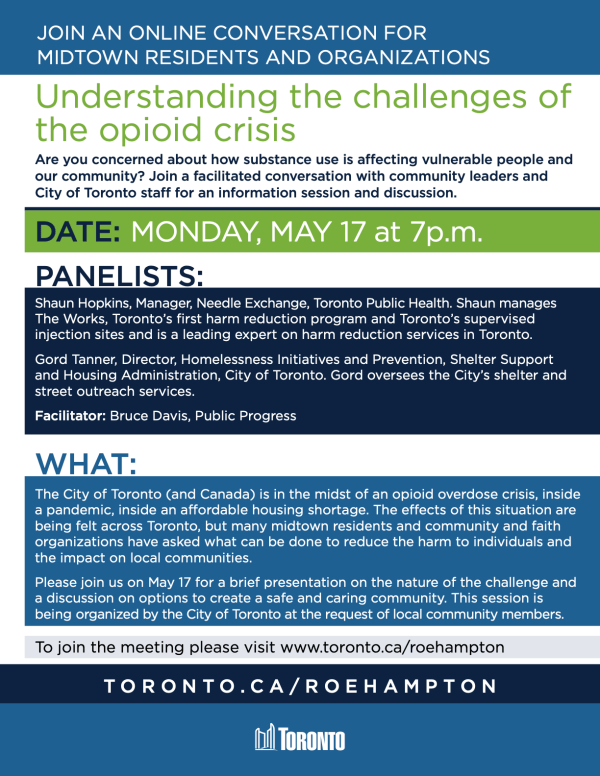
As the Roehampton shelter project settles in, there seems to be less anxiety about its presence. Let us hope so. Meanwhile, amidst the pandemic, the opioid problem, with all its suffering and dangers, is no better; it may be even worse. Good solutions require an open mind and ingenuity, and compassion too. Here is an invitation to a meeting on Monday, May 17, chaired by Bruce Davies. We in EPRA have met Bruce in his work chairing the Canada Square Working Group now in session; we have come to admire his deft skill and graciousness. It should be an illuminating discussion of some very complex issues.

EPRA

Create a website or blog at WordPress.com

Up ↑